
By Kaliper | Growth Analytics & Attribution Consulting
The Monday Morning Problem
Every Monday morning, growth teams at Shopify brands across the US and Canada open the same set of dashboards. Meta Ads Manager. Google Analytics. TikTok Ads. Klaviyo. And then they open Shopify.
The numbers don’t match. They never quite match.
Most teams have learned to live with the gap, to mentally adjust, to trust one platform over another, to explain it away as “platform discrepancy.” But that gap isn’t a reporting quirk. It is costing brands real money, often without anyone realizing it.
At Kaliper, we have worked with over 100 Shopify brands on their growth analytics and attribution setups. Across every engagement, different industries, different ad mixes, different team sizes, one problem comes up more consistently than any other: attribution keeps breaking. In our experience, it is the single largest pain point for growth marketers today. Not creative fatigue, not rising CPMs, not platform changes, though all of those matter. The thing that causes the most paralysis, the most bad decisions, and the most wasted budget is not being able to trust the numbers sitting in front of you.
This post explains why attribution has become so broken for ecommerce brands, what the data actually says, and what fixing it looks like in practice.
The Scale of the Problem
Attribution has always been imperfect. But in the last three years, several structural shifts have compounded to make it genuinely unreliable for most ecommerce brands.
The numbers are stark:
- 38% of marketers say attribution is their single biggest analytics challenge, ahead of budget limitations and talent gaps. (Source: Marketing LTB, Marketing Attribution Statistics 2025)
- 55% of ecommerce brands struggle with attribution accuracy specifically. (Source: Marketing LTB, Ecommerce Advertising Statistics 2026)
- 22% of organisations still rely exclusively on last-click attribution, a model that was already outdated before cookie deprecation. (Source: Marketing LTB, Marketing Attribution Statistics 2025)
- 60–75% of marketers say their own attribution data lacks rigour and trust. (Source: IAB State of Data 2026, cited by XICTRON)
For brands spending $50K–$500K per month on paid media, this isn’t an academic problem. An 20% misattribution on a $200K monthly ad budget means $40K per month allocated to channels based on wrong data.
What Actually Broke — and When
1. Apple’s iOS 14.5 update (April 2021)
Apple’s App Tracking Transparency (ATT) framework required apps to request permission before tracking users across other apps and websites. The majority of users opted out. For Meta advertisers in particular, this wiped out a significant portion of mobile attribution data almost overnight.
The effect compounded over subsequent iOS updates. By 2024, mobile attribution via pixel-based tracking had become fundamentally incomplete for any brand running paid social.
2. Third-party cookie deprecation
Chrome’s gradual deprecation of third-party cookies, completed across 2024–2025, made cookieless infrastructure mandatory rather than experimental for any brand that relies on cross-site tracking. (Source: Improvado, Cookieless Attribution 2026)
The accuracy impact is measurable: while cookie-based attribution historically achieved 85–90% accuracy, cookieless methods range from 50–85% depending on approach. Identity graphs reach the higher end (70–85%), while probabilistic matching sits at 50–65%. (Source: Improvado)
The implication: brands that have not actively rebuilt their attribution infrastructure are now operating on data that may be 15–50% incomplete.
3. Platform self-attribution
Even before cookie deprecation, each ad platform was incentivised to claim as much conversion credit as possible. Meta counts a conversion if a user saw or clicked an ad within a 7-day window. Google counts a conversion if the user clicked a search ad on any prior session. TikTok has its own attribution window.
The result is that all three platforms claim full or partial credit for the same purchase. Your total attributed conversions across platforms can easily exceed your actual Shopify order count by 30–50%.
This is not a bug. It is how each platform is designed.
4. The proliferation of touchpoints
The average consumer today interacts with 8–10 touchpoints before a single purchase. (Source: Search Engine Journal, Top 10 Digital Marketing Trends for 2026) Those touchpoints span paid search, paid social, organic social, email, SMS, influencer content, and increasingly AI-powered search results and social commerce.
Last-click attribution, still used by 22% of organisations, assigns 100% of the credit to whichever touchpoint came immediately before the purchase. For most Shopify brands with multi-channel acquisition, this structurally under-credits upper-funnel channels (brand awareness, video, influencer) and over-credits lower-funnel channels (branded search, retargeting).
The consequence: brands systematically defund the channels that create demand, and over-invest in channels that simply capture it.
What Proper Attribution Actually Looks Like in 2026
The good news: the tools and methodologies to fix this exist. The challenge is that implementing them requires expertise, not just software.
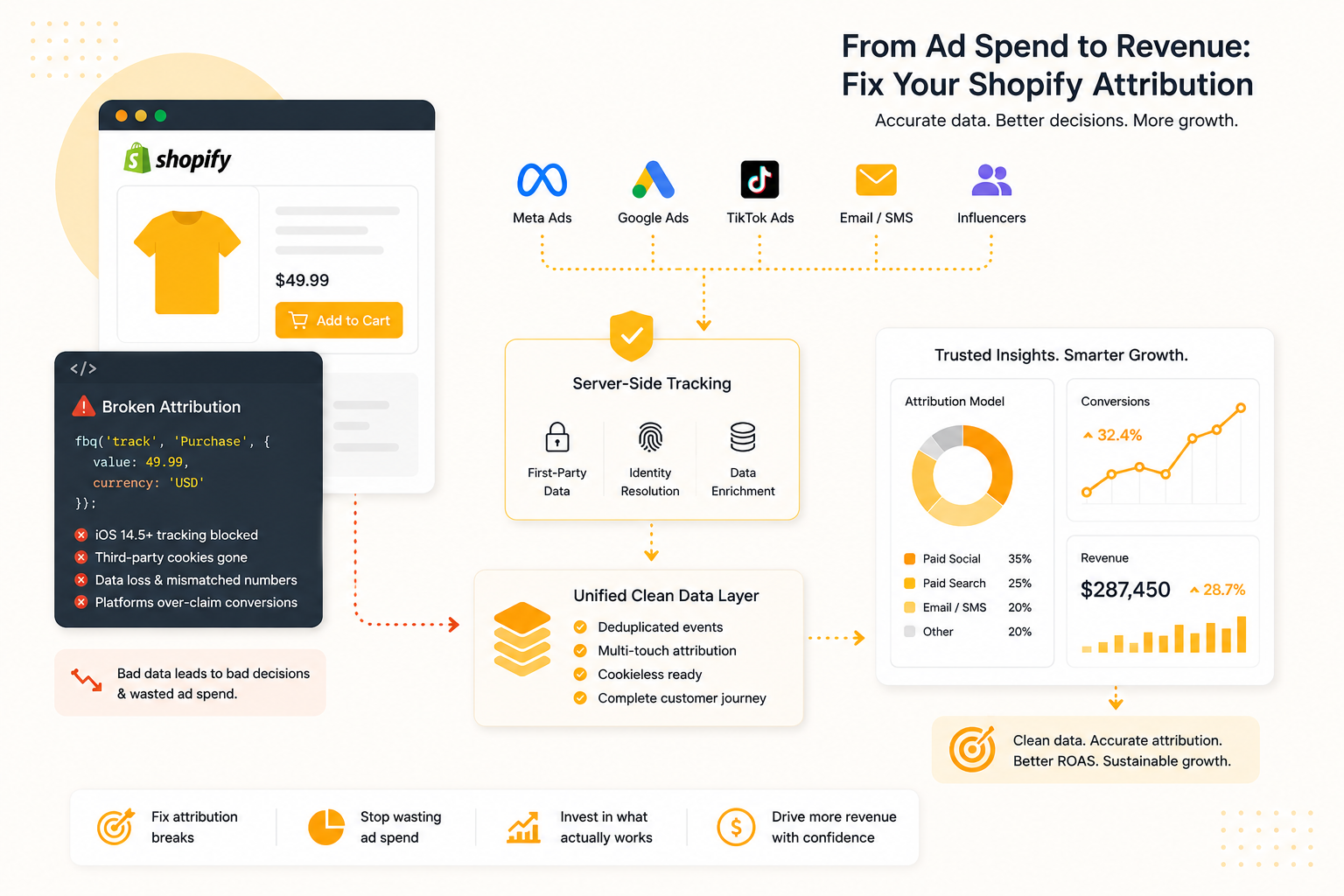
Server-side tracking
Moving event tracking from the browser (where it can be blocked by ad blockers, iOS, and cookie restrictions) to the server dramatically improves data completeness. Server-side tracking improves data accuracy by 13–27% compared to browser-only tracking. (Source: Marketing LTB) Yet only 1 in 5 advertisers has fully implemented server-side event capture. (Source: Marketing LTB)
First-party data collection
With third-party data unreliable, brands that invest in first-party data, email capture, post-purchase surveys, customer identity resolution, have a structural advantage. Zero-party data (data customers voluntarily provide) increases attribution accuracy by 16%. (Source: Marketing LTB) Brands that unify CRM and ad data see 30–50% better attribution accuracy. (Source: Marketing LTB, Programmatic Advertising Statistics 2026)
Multi-touch attribution models
Moving from last-click to multi-touch attribution, linear, time-decay, or data-driven — more accurately distributes credit across the customer journey. Multi-touch attribution improves CPA efficiency by 14–36% depending on channel mix. (Source: Marketing LTB)
Marketing Mix Modelling (MMM)
For brands spending $100K+ per month, MMM, statistical modelling that analyses the relationship between spend and revenue at an aggregate level, provides a macro-level check on channel performance that doesn’t depend on individual user tracking at all. The leading approach in 2026 is running MTA and MMM in parallel, using AI to reconcile the two. Hybrid MMM + MTA AI delivers the largest single accuracy improvement: +27 percentage points in holdout-test fidelity vs deterministic baseline models. (Source: Digital Applied, Marketing Attribution Statistics 2026)
The Business Impact of Getting This Right
Attribution accuracy is not a reporting exercise. It is a revenue lever.
- Proper attribution reduces wasted ad spend by 27% on average. (Source: Marketing LTB)
- Attribution-driven companies scale winning campaigns 2.1x faster. (Source: Marketing LTB)
- Companies with data-driven attribution achieve 1.7x faster revenue growth. (Source: Marketing LTB)
- Attribution can reduce Customer Acquisition Cost (CAC) by 8–24% depending on maturity. (Source: Marketing LTB)
- Attribution-capable teams have marketing-sourced pipeline 1.6x larger than teams without it, despite spending only 23% more on martech. (Source: Digital Applied)
For a Shopify brand doing $15M in annual revenue with a 30% ad-to-revenue ratio, a 27% reduction in wasted ad spend represents over $1.2M recovered annually.
The Warning Signs Your Attribution Is Broken
Based on our work with over 100 Shopify brands, these are the most common indicators that your attribution setup needs attention:
1. Your ad platform totals don’t add up to your Shopify revenue. If the sum of attributed conversions across Meta, Google, and TikTok consistently exceeds your Shopify order count, you have double-counting. This is almost universal for brands running multiple paid channels with default attribution windows.
2. Your “best performing” channel doesn’t move when you scale it. If increasing spend on a channel doesn’t proportionally increase revenue, that channel may be getting credit for conversions driven elsewhere — typically by brand search or email.
3. You can’t explain a revenue spike or drop. If your team can’t point to a specific campaign or channel when revenue moves significantly, your attribution model isn’t giving you enough signal to act on.
4. You’re optimising for ROAS but profitability is declining. ROAS reported by ad platforms is based on attributed conversions. If those attribution numbers are inflated, your real ROAS is lower than it appears — and scaling based on that number accelerates the problem. Notably, 49% of ecommerce brands say profitability is declining despite higher sales. (Source: Marketing LTB)
5. You switched tools but the problem didn’t go away. A different dashboard doesn’t fix broken underlying data. If you’ve moved from GA4 to Triple Whale to Northbeam and still don’t trust the numbers, the issue is typically in your tracking implementation and attribution model configuration — not the reporting layer on top.
What Kaliper Does
Kaliper is a growth analytics and attribution consultancy working exclusively with Shopify brands doing $10M–$50M in annual GMV.
We are not a software company. We don’t sell a platform or a subscription. We work with your existing stack, whatever tools you already have, and fix the gaps in how your data is collected, modelled, and used to make decisions.
Our engagements typically follow one of two paths:
Attribution audit (project-based) A fixed-scope, fixed-price engagement where we review your entire attribution setup: tracking implementation, UTM structure, attribution windows, cross-channel reconciliation, and the gap between platform-reported and Shopify-reported revenue. You get a detailed findings report and a prioritised action plan. Most audits complete in 3–4 weeks.
Ongoing analytics retainer For brands that want a permanent fix rather than a one-time review, we operate as an embedded analytics partner: maintaining your tracking infrastructure, producing a weekly revenue attribution report, and advising on channel allocation decisions as your mix evolves.
A Free Attribution Audit
If your dashboards and your Shopify revenue have never quite matched or if you’re making significant channel decisions and not fully trusting the data behind them we’d like to help.
We’re currently offering free 30-minute attribution audit calls for Shopify brands doing $10M+ in annual GMV. No pitch. No obligation. Just an honest assessment of where your data is reliable and where it isn’t.
Kaliper is a growth analytics and attribution consultancy for Shopify brands. We help marketing teams trust their data and make better channel decisions.
More field notes
All field notesWorking through this in your own stack?
We do this for a living. Bring one dashboard you don't trust and we'll tell you why the number is wrong.