
Most companies don’t plan their data pipeline. It grows one integration at a time — a Segment account here, a Fivetran connector there, a spreadsheet someone built to patch a gap nobody had time to fix properly. It works, until the day a dashboard doesn’t match another dashboard, or a new tool needs three weeks of engineering time just to get connected.
That’s usually the point where “we have a data pipeline” turns into “we need data pipeline architecture.” The difference matters. Having tools connected isn’t the same as having a system that scales, survives a team change, and produces numbers people trust without checking twice.
This guide covers what data pipeline architecture actually means, how CDPs fit into the picture, the signs your pipeline needs structural work, and what to expect from a consulting engagement.
What Is Data Pipeline Architecture?
Data pipeline architecture is the overall design for how data moves through your company: where it comes from, how it’s transformed, where it’s stored, and where it ends up. It’s the blueprint behind the tools, not the tools themselves.
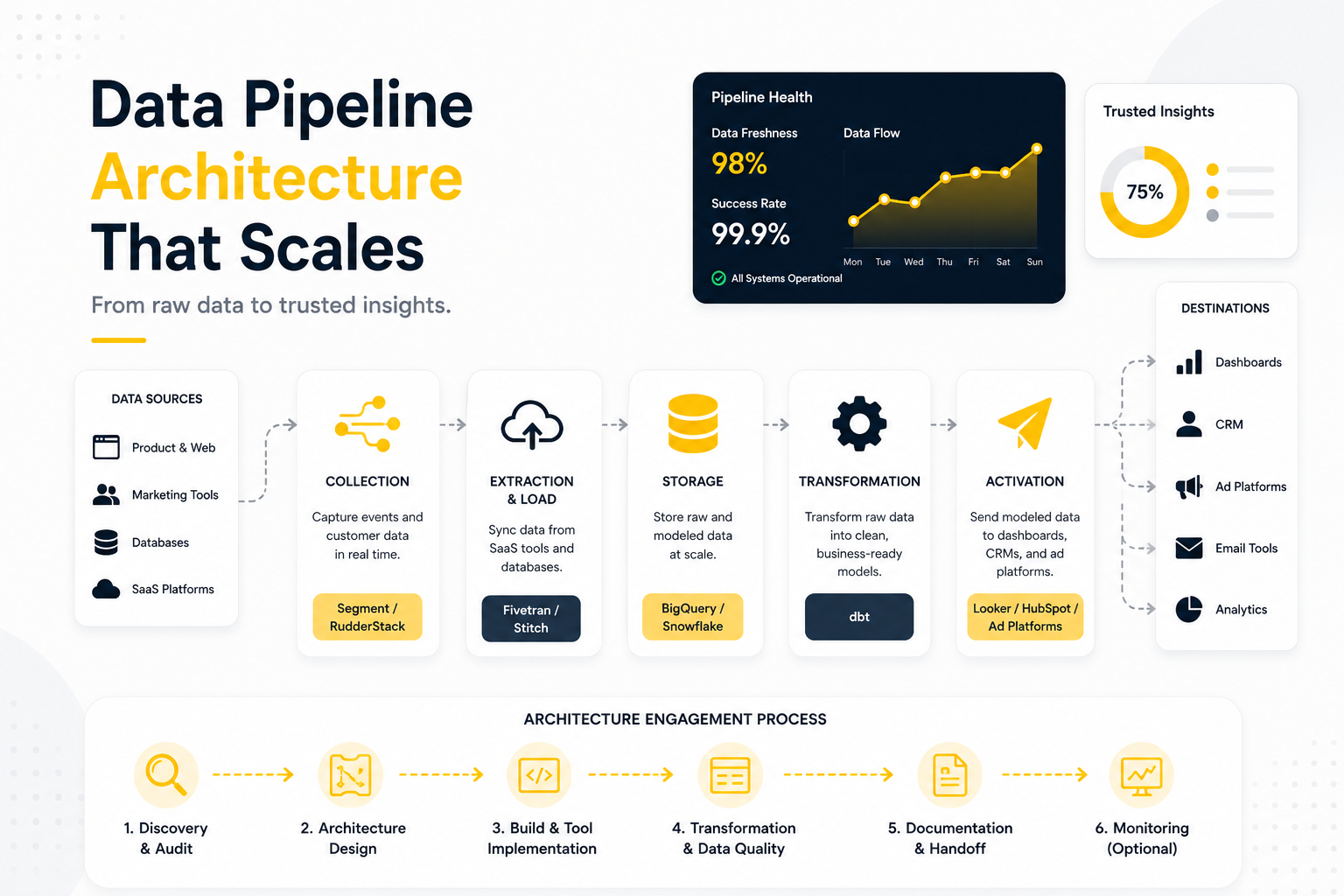
A well-designed pipeline follows a consistent pattern: collect data from its source, load it into a central warehouse, transform it into clean models, then send it out to the dashboards and tools your team actually uses.
Every layer matters on its own, but the system only works well when they’re designed together. A fast CDP feeding a poorly modeled warehouse still produces unreliable dashboards — the bottleneck just moves further down the pipeline.
CDP vs. Data Pipeline: What’s the Difference?
These two terms get used interchangeably, but they solve different problems. A customer data platform (CDP) like Segment or RudderStack focuses on collecting events and customer data, then routing it to multiple destinations in real time. A data pipeline is the broader system: it includes the CDP as one piece, alongside ELT tools, the warehouse, and the transformation layer that turns raw data into something usable.
Think of it this way: the CDP is the part of the pipeline that handles fast-moving event data, like a sign-up or a button click, the moment it happens. The rest of the pipeline handles everything else, including data that doesn’t need to move in real time, like a daily sync from your CRM or ad platform.
In practice, most growing companies need both. The CDP handles real-time event collection. The rest of the pipeline handles everything else: syncing SaaS tools, modeling the data, and feeding it back out to the business.
Signs Your Data Pipeline Needs Architectural Help
These patterns show up consistently in companies that have outgrown their original setup:
- Someone on the team manually exports CSVs to stitch data together every week
- Two dashboards report different numbers for what should be the same metric
- Engineering spends recurring time firefighting broken syncs instead of building
- There’s no single source of truth for customer or revenue data
- Adding a new tool means rebuilding integrations from scratch
- Warehouse costs are climbing faster than the value the data is producing
Any one of these is manageable. Three or more usually means the pipeline has outgrown the architecture it was built on.
What a Data Pipeline Architecture Engagement Includes
A structured engagement typically moves through six stages:
1. Discovery and Source Audit
The consultant maps every data source feeding the business today, from product events to ad platforms to internal databases, and identifies where data is duplicated, missing, or inconsistent. This stage usually surfaces a few high-impact fixes that can ship before the full design is finalized.
2. Architecture Design
This stage defines the target architecture: which tools handle collection, which handle syncing, what the warehouse schema looks like, and how data flows between each layer. The output is a design the team can build against, not a vague diagram, including how each new data source will be onboarded going forward.
3. Pipeline Build and Tool Implementation
Connectors are configured, the CDP is implemented if needed, and the warehouse is set up to receive data on a reliable schedule. This is where Fivetran, Stitch, Segment, or RudderStack are actually wired into the stack, with credentials, sync frequency, and error handling configured up front.
4. Transformation and Data Quality
Raw data is modeled into clean, business-ready tables, typically using dbt. Testing is built in at this stage, so broken data is caught before it reaches a dashboard instead of after, and naming conventions are standardized across every model.
5. Documentation and Handoff
The architecture, schema, and transformation logic are documented, so the next engineer who touches the pipeline isn’t starting from zero. This typically includes a diagram of the full data flow alongside the technical documentation.
6. Ongoing Monitoring (Optional)
Pipelines break quietly when a source API changes or a connector silently fails. Many teams keep a consultant on retainer specifically to monitor for this and fix it before it affects reporting, usually at a fraction of the original build cost.
Choosing the Right Tools for Your Pipeline
The right tool depends on what you’re moving and how much control you need over it:
A data pipeline architecture consultant should be able to justify each tool choice against your actual data volume and team size, rather than defaulting to whichever stack they’ve implemented most often.
Build vs. Buy: When Off-the-Shelf Tools Are Enough
Not every company needs a fully custom pipeline. The right call usually comes down to scale and complexity:
- Off-the-shelf tools like Fivetran and Segment cover most standard SaaS-to-warehouse syncing without custom code
- Custom pipelines make sense when data volume is high, sources are non-standard, or latency requirements are strict
- Many companies start with off-the-shelf connectors and only build custom pipelines for the few sources that need it
An ETL pipeline consultant’s job is to draw that line for your specific setup, not to push a fully custom build by default. The right architecture is the one that matches your actual data volume today, with a clear path to scale once you outgrow it.
Common Data Pipeline Mistakes Consultants Are Brought In to Fix
These issues show up across most pipeline audits, regardless of company size:
Direct, point-to-point integrations between tools instead of routing everything through a central warehouse
- No version control or testing on transformation logic, so a single SQL change can silently break dashboards
- Duplicate or conflicting customer records because no source is treated as the single source of truth
- Connectors left unmonitored, so a broken sync goes unnoticed for weeks
- Warehouse schemas designed around one tool’s defaults instead of the business questions the data needs to answer
How to Choose a Data Pipeline Architecture Consultant
Before hiring one, check for:
- Hands-on implementation experience across multiple CDPs and ELT tools, not just one stack
- A clear design process that produces a documented architecture, not just a working pipeline
- Experience with dbt or another transformation layer, not just raw data loading
- A testing and monitoring plan for after launch, not only the initial build
- Comfort working with your existing warehouse, whether that’s BigQuery, Snowflake, or Redshift
Kaliper has designed and built data pipelines for 100+ clients over 8+ years, across Segment, RudderStack, Fivetran, Stitch, dbt, BigQuery, Snowflake, and Redshift. If your pipeline is held together with manual exports and quiet workarounds, that’s an architecture problem — and it’s fixable.
Talk to a Kaliper data pipeline architecture consultant: book a free discovery call.
More field notes
All field notesWorking through this in your own stack?
We do this for a living. Bring one dashboard you don't trust and we'll tell you why the number is wrong.